Assembly Language for the Ibm Pc Family "Arithmetic and the Flags"
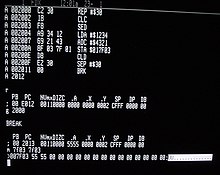
In computer programming, machine code is whatsoever low-level programming language, consisting of machine language instructions, which are used to command a computer's central processing unit (CPU). Each instruction causes the CPU to perform a very specific task, such equally a load, a store, a bound, or an arithmetics logic unit (ALU) operation on one or more units of data in the CPU's registers or memory.
Machine code is a strictly numerical language which is designed to run equally fast equally possible, and may be considered as the lowest-level representation of a compiled or assembled computer plan or as a primitive and hardware-dependent programming language. While it is possible to write programs direct in auto lawmaking, managing private bits and calculating numerical addresses and constants manually is ho-hum and mistake-prone. For this reason, programs are very rarely written directly in car code in modernistic contexts, but may exist washed for low level debugging, program patching (especially when assembler source is not available) and assembly language disassembly.
The majority of applied programs today are written in higher-level languages or assembly language. The source lawmaking is then translated to executable machine code by utilities such equally compilers, assemblers, and linkers, with the important exception of interpreted programs,[nb 1] which are not translated into machine lawmaking. However, the interpreter itself, which may be seen as an executor or processor performing the instructions of the source code, typically consists of directly executable machine code (generated from associates or loftier-level language source code).
Car code is by definition the lowest level of programming item visible to the programmer, merely internally many processors utilise microcode or optimise and transform machine lawmaking instructions into sequences of micro-ops. This is non by and large considered to be a machine code.
Instruction fix [edit]
Every processor or processor family has its ain instruction set. Instructions are patterns of bits, digits or characters that correspond to car commands. Thus, the instruction prepare is specific to a course of processors using (more often than not) the aforementioned compages. Successor or derivative processor designs often include instructions of a predecessor and may add new boosted instructions. Occasionally, a successor pattern will discontinue or change the significant of some instruction code (typically because it is needed for new purposes), affecting code compatibility to some extent; even compatible processors may show slightly dissimilar beliefs for some instructions, just this is rarely a problem. Systems may also differ in other details, such as retentiveness organisation, operating systems, or peripheral devices. Considering a programme normally relies on such factors, different systems volition typically non run the aforementioned automobile lawmaking, even when the same blazon of processor is used.
A processor'south teaching set may have all instructions of the same length, or it may have variable-length instructions. How the patterns are organized varies with the particular architecture and type of didactics. Most instructions have i or more opcode fields which specifies the basic instruction type (such every bit arithmetic, logical, jump, etc.), the functioning (such as add or compare), and other fields that may give the type of the operand(southward), the addressing way(south), the addressing first(south) or index, or the operand value itself (such abiding operands independent in an educational activity are called immediate).[ane]
Not all machines or individual instructions have explicit operands. An accumulator machine has a combined left operand and result in an implicit accumulator for virtually arithmetic instructions. Other architectures (such as 8086 and the x86-family) have accumulator versions of common instructions, with the accumulator regarded every bit one of the general registers past longer instructions. A stack machine has most or all of its operands on an implicit stack. Special purpose instructions too often lack explicit operands (CPUID in the x86 compages writes values into four implicit destination registers, for case). This distinction between explicit and implicit operands is important in code generators, especially in the register allocation and live range tracking parts. A good code optimizer tin can rails implicit as well as explicit operands which may allow more frequent constant propagation, constant folding of registers (a annals assigned the result of a abiding expression freed upwards by replacing it by that constant) and other lawmaking enhancements.
Programs [edit]
A computer program is a list of instructions that can exist executed by a central processing unit of measurement (CPU). A program's execution is done in lodge for the CPU that is executing it to solve a trouble and thus accomplish a outcome. While unproblematic processors are able to execute instructions ane after some other, superscalar processors are capable of executing many instructions simultaneously.
Program flow may be influenced past special 'jump' instructions that transfer execution to an address (and hence pedagogy) other than the side by side numerically sequential address. Whether these conditional jumps occur is dependent upon a status such equally a value being greater than, less than, or equal to another value.
Assembly languages [edit]
A much more human friendly rendition of machine language, chosen assembly language, uses mnemonic codes to refer to automobile code instructions, rather than using the instructions' numeric values directly, and uses symbolic names to refer to storage locations and sometimes registers. For example, on the Zilog Z80 processor, the machine lawmaking 00000101, which causes the CPU to decrement the B processor register, would be represented in assembly language as Dec B.
Example [edit]
The MIPS compages provides a specific example for a machine code whose instructions are always 32 bits long. The general blazon of educational activity is given by the op (operation) field, the highest half dozen bits. J-blazon (jump) and I-type (immediate) instructions are fully specified by op. R-type (annals) instructions include an additional field funct to determine the exact operation. The fields used in these types are:
half-dozen 5 5 5 5 6 $.25 [ op | rs | rt | rd |shamt| funct] R-type [ op | rs | rt | address/immediate] I-type [ op | target accost ] J-type
rs, rt, and rd indicate register operands; shamt gives a shift amount; and the address or immediate fields contain an operand directly.
For example, adding the registers 1 and 2 and placing the result in register 6 is encoded:
[ op | rs | rt | rd |shamt| funct] 0 1 two half dozen 0 32 decimal 000000 00001 00010 00110 00000 100000 binary
Load a value into register eight, taken from the memory jail cell 68 cells after the location listed in register iii:
[ op | rs | rt | accost/immediate] 35 iii 8 68 decimal 100011 00011 01000 00000 00001 000100 binary
Jumping to the address 1024:
[ op | target address ] two 1024 decimal 000010 00000 00000 00000 10000 000000 binary
Overlapping instructions [edit]
On processor architectures with variable-length educational activity sets[2] (such equally Intel's x86 processor family) it is, within the limits of the control-flow resynchronizing phenomenon known as the Kruskal Count,[3] [2] sometimes possible through opcode-level programming to deliberately arrange the resulting code then that two code paths share a common fragment of opcode sequences. These are chosen overlapping instructions, overlapping opcodes, overlapping code, overlapped code, instruction scission, or jump into the middle of an instruction, and correspond a form of superposition.[4] [5] [half dozen]
In the 1970s and 1980s, overlapping instructions were sometimes used to preserve retention space. 1 example were in the implementation of fault tables in Microsoft'southward Altair BASIC, where interleaved instructions mutually shared their instruction bytes.[7] [two] [4] The technique is rarely used today, but might still be necessary to resort to in areas where extreme optimization for size is necessary on byte-level such every bit in the implementation of boot loaders which take to fit into boot sectors.[nb 2]
It is also sometimes used every bit a lawmaking obfuscation technique as a mensurate against disassembly and tampering.[2]
The principle is as well utilized in shared code sequences of fatty binaries which must run on multiple educational activity-set-incompatible processor platforms.
This property is likewise used to discover unintended instructions called gadgets in existing code repositories and is utilized in return-oriented programming as culling to lawmaking injection for exploits such as return-to-libc attacks.[8] [2]
Relationship to microcode [edit]
In some computer architectures, the machine code is implemented by an even more cardinal underlying layer called microcode, providing a common machine language interface across a line or family of dissimilar models of figurer with widely dissimilar underlying dataflows. This is washed to facilitate porting of machine language programs between different models. An example of this apply is the IBM System/360 family of computers and their successors. With dataflow path widths of eight bits to 64 $.25 and beyond, they nevertheless present a common compages at the machine language level across the entire line.
Using microcode to implement an emulator enables the computer to present the compages of an entirely different figurer. The System/360 line used this to let porting programs from earlier IBM machines to the new family of computers, e.g. an IBM 1401/1440/1460 emulator on the IBM S/360 model twoscore.
Relationship to bytecode [edit]
Machine code is generally different from bytecode (also known as p-code), which is either executed by an interpreter or itself compiled into machine code for faster (straight) execution. An exception is when a processor is designed to use a detail bytecode directly as its machine code, such as is the case with Java processors.
Machine lawmaking and assembly code are sometimes called native code when referring to platform-dependent parts of language features or libraries.[9]
Storing in memory [edit]
The Harvard architecture is a computer compages with physically separate storage and signal pathways for the lawmaking (instructions) and data. Today, most processors implement such split signal pathways for functioning reasons only implement a Modified Harvard architecture,[ commendation needed ] and so they can support tasks similar loading an executable program from disk storage as data and and then executing information technology. Harvard architecture is contrasted to the Von Neumann architecture, where data and code are stored in the same memory which is read by the processor allowing the estimator to execute commands.
From the point of view of a process, the lawmaking infinite is the role of its accost space where the lawmaking in execution is stored. In multitasking systems this comprises the plan'due south code segment and ordinarily shared libraries. In multi-threading environment, different threads of 1 procedure share code space along with data space, which reduces the overhead of context switching considerably as compared to process switching.
Readability by humans [edit]
Pamela Samuelson wrote that machine lawmaking is so unreadable that the United States Copyright Office cannot identify whether a particular encoded program is an original work of authorship;[10] however, the United states of america Copyright Office does allow for copyright registration of computer programs[11] and a program's machine lawmaking can sometimes exist decompiled in order to make its functioning more easily understandable to humans.[12] Even so, the output of a decompiler or disassembler will be missing the comments and symbolic references, so while the output may exist easier to read than the object code, it will all the same be more difficult than the original source lawmaking. This problem does not exist for object-code formats similar SQUOZE, where the source lawmaking is included in the file.
Cognitive science professor Douglas Hofstadter has compared automobile code to genetic lawmaking, saying that "Looking at a program written in machine language is vaguely comparable to looking at a Deoxyribonucleic acid molecule atom by atom."[13]
See also [edit]
- Assembly language
- Endianness
- Listing of automobile languages
- Machine code monitor
- Overhead lawmaking
- P-code machine
- Reduced didactics set up computing (RISC)
- Very long education word
- Didactics Machine Code: Micro-Professor MPF-I
Notes [edit]
- ^ Such as many versions of Bones, especially early ones, equally well every bit Smalltalk, MATLAB, Perl, Python, Ruby and other special purpose or scripting languages.
- ^ As an example, the DR-DOS MBRs and boot sectors (which also hold the partitioning table and BIOS Parameter Cake, leaving less than 446 respectively 423 bytes for the code) were traditionally able to locate the boot file in the file system by themselves and load it into retentivity as a whole, in dissimilarity to their counterparts in MS-DOS/PC DOS, which instead relied on the system files to occupy the start ii directory entries in the file organization and the kickoff iii sectors of IBMBIO.COM to be stored at the first of the information area in contiguous sectors containing a secondary loader to load the residuum of the file into memory (requiring SYS to take care of all these weather). When FAT32 and LBA support was added, Microsoft even switched to require 386 instructions and splitted the boot lawmaking over two sectors for code size reasons, which was no choice to follow for DR-DOS every bit it would have broken backward- and cross-compatibility with other operating systems in multi-boot and chain load scenarios, likewise equally with older PCs. Instead, the DR-DOS vii.07 kicking sectors resorted to self-modifying code, opcode-level programming in machine language, controlled utilization of (documented) side effects, multi-level data/code overlapping and algorithmic folding techniques to notwithstanding fit everything into a concrete sector of simply 512 bytes without giving up any of their extended functionality.
References [edit]
- ^ Kjell, Bradley. "Immediate Operand".
- ^ a b c d e Jacob, Matthias; Jakubowski, Mariusz H.; Venkatesan, Ramarathnam (20–21 September 2007). Towards Integral Binary Execution: Implementing Oblivious Hashing Using Overlapped Instruction Encodings (PDF). Proceedings of the ninth workshop on Multimedia & Security (MM&Sec '07). Dallas, Texas, USA: Association for Computing Machinery. pp. 129–140. CiteSeerX10.1.1.69.5258. doi:x.1145/1288869.1288887. ISBN978-one-59593-857-ii. S2CID 14174680. Archived (PDF) from the original on 2018-09-04. Retrieved 2021-12-25 . (12 pages)
- ^ Lagarias, Jeffrey C.; Rains, Eric; Vanderbei, Robert J. (2009) [2001-ten-13]. Brams, Stephen; Gehrlein, William V.; Roberts, Fred S. (eds.). The Kruskal Count (PDF). The Mathematics of Preference, Choice and Society. Essays in Accolade of Peter J. Fishburn. Berlin / Heidelberg, Federal republic of germany: Springer-Verlag. pp. 371–391. arXiv:math/0110143. ISBN978-3-540-79127-0. Archived (PDF) from the original on 2021-12-25. Retrieved 2021-12-25 . (22 pages)
- ^ a b "Unintended Instructions on x86". Hacker News. 2021. Archived from the original on 2021-12-25. Retrieved 2021-12-24 .
- ^ Kinder, Johannes (2010-09-24). Static Assay of x86 Executables [Statische Analyse von Programmen in x86 Maschinensprache] (PDF) (Dissertation). Munich, Germany: Technische Universität Darmstadt. D17. Archived from the original on 2020-eleven-12. Retrieved 2021-12-25 . (199 pages)
- ^ "What is "overlapping instructions" obfuscation?". Contrary Applied science Stack Exchange. 2013-04-07. Archived from the original on 2021-12-25. Retrieved 2021-12-25 .
- ^ Gates, William "Bill" Henry, Personal communication (NB. According to Jacob et al.)
- ^ Shacham, Hovav (2007). The Geometry of Innocent Flesh on the Bone: Render-into-libc without Role Calls (on the x86) (PDF). Proceedings of the ACM, CCS 2007. ACM Printing. Archived (PDF) from the original on 2021-12-fifteen. Retrieved 2021-12-24 .
- ^ "Managed, Unmanaged, Native: What Kind of Code Is This?". developer.com. 2003-04-28. Retrieved 2008-09-02 .
- ^ Samuelson, Pamela (September 1984). "CONTU Revisited: The Example against Copyright Protection for Reckoner Programs in Machine-Readable Form". Knuckles Law Journal. 1984 (4): 663–769. doi:10.2307/1372418. JSTOR 1372418. PMID 10268940.
- ^ "Copyright Registration for Computer Programs" (PDF). US Copyright Role. August 2008. Retrieved 2014-02-23 .
- ^ "What is decompile? - Definition from WhatIs.com". WhatIs.com . Retrieved 2016-12-26 .
- ^ Hofstadter, Douglas R. (1980). Gödel, Escher, Bach: An Eternal Golden Braid. p. 290.
Further reading [edit]
- Hennessy, John L.; Patterson, David A. (1994). Computer Organization and Design. The Hardware/Software Interface . Morgan Kaufmann Publishers. ISBN1-55860-281-X.
- Tanenbaum, Andrew South. (1999). Structured Reckoner Organization. Prentice Hall. ISBN0-13-020435-viii.
- Brookshear, J. Glenn (2007). Computer Scientific discipline: An Overview. Addison Wesley. ISBN978-0-321-38701-ane.
Source: https://en.wikipedia.org/wiki/Machine_code

Post a Comment for "Assembly Language for the Ibm Pc Family "Arithmetic and the Flags""